
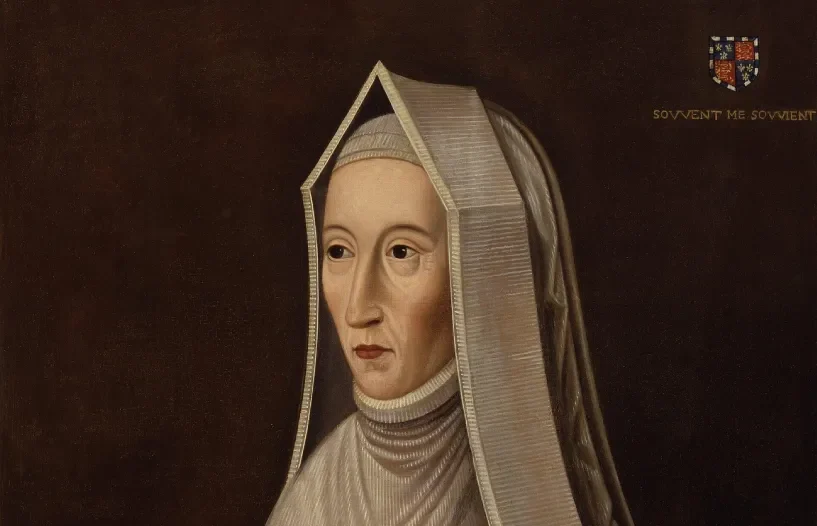

You may never have heard of Margaret Beaufort. A woman of astonishing intelligence and foresight, she has only recently begun to get proper credit as the mastermind behind several watershed moments in English history.
But what now looks like the inevitability of history was once just a thirteen-year-old girl: widowed, pregnant, and facing a labor that would nearly kill her. One fragile life, born in the cold January of 1457, would change England forever.
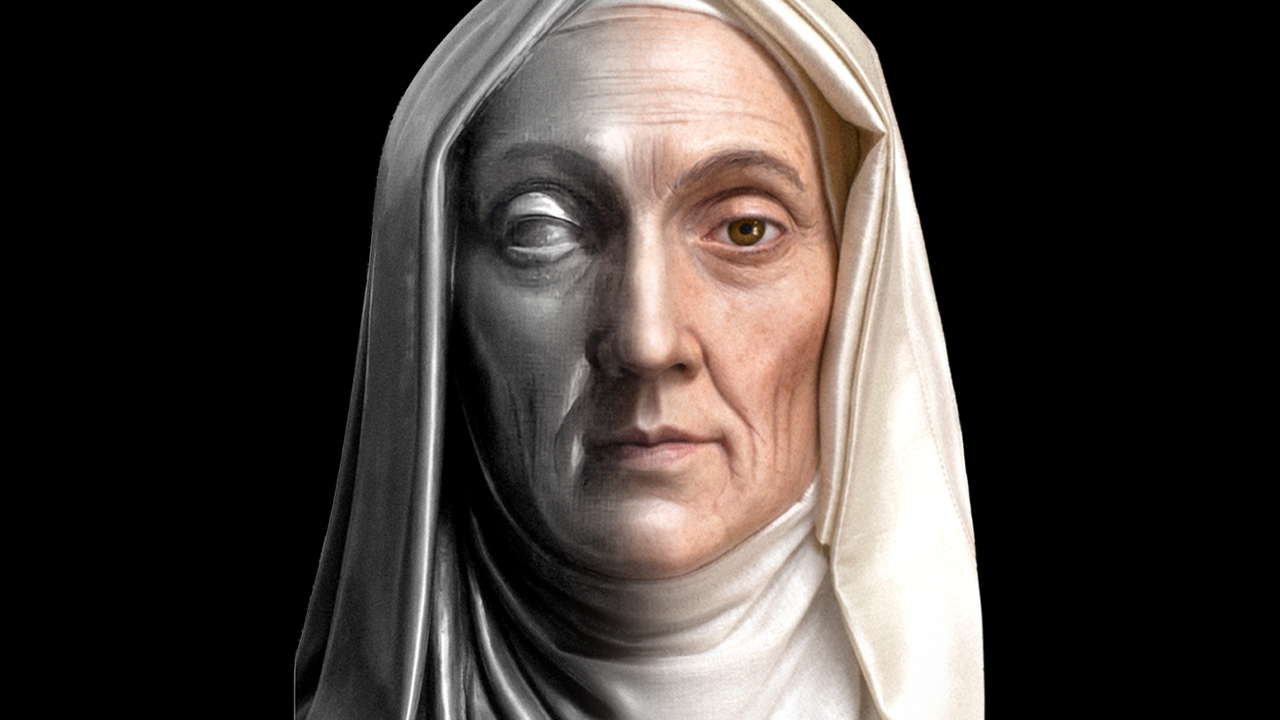
If you’d rather watch this article in video format, check out her 15 minute history & facial reconstructios video here.
Six Facts About Margaret Beaufort
1. Her bloodline was both her fortune and her curse
Margaret was born on May 31, 1443, at Bletsoe Castle in Bedfordshire, the only child of John Beaufort, Duke of Somerset. She was the great-granddaughter of John of Gaunt, one of the sons of Edward III — but through the Beaufort line, born of Gaunt’s long affair with Katherine Swynford and legitimised only after the fact. She was of royal descent with an asterisk permanently attached, and that asterisk shaped everything that happened to her.
Her father died in May 1444, days before her first birthday. He had fallen catastrophically from the favour of Henry VI after a disastrous campaign in France, and it was widely believed at the time that he took his own life rather than face his disgrace.
With no siblings, that left the infant Margaret one of the wealthiest heiresses in England. And in the fifteenth century, that meant she was treated as nothing more than a valuable bargaining chip.
2. She was legally married by the age of three, and a widowed mother by thirteen
Margaret stayed in her mother’s household, but the king granted the wardship of her estate – the lands, the income, the marriage rights – to William de la Pole, Duke of Suffolk. Suffolk moved fast, betrothing her to his own son, John de la Pole, and the two were legally married before she was three.
The union was dissolved in early 1453, after Suffolk’s fall from power, and Margaret herself never counted it among her marriages. She always named a different man as her first husband.
Henry VI shifted her wardship to his own Tudor half-brothers, Edmund and Jasper. At nine, Margaret was required to give her consent to marry Edmund. At twelve, in November 1455, the marriage took place. Edmund was roughly twice her age.
It is genuinely hard to read about what befell this child before she turned thirteen. With no father and no brothers to protect her in a deeply patriarchal world, she was a sitting duck for anyone who wanted what she had.
We have no record of how Edmund treated her, and no record whatsoever of her own thoughts on any of it. He may well have been a considerate husband by the standards of his time. He was not, however, considerate enough to wait until she was physically mature before getting her pregnant.
3. The birth that made the Tudor dynasty nearly ended it
As England slid into the civil wars we now call the Wars of the Roses, Edmund was captured by Yorkist forces and imprisoned at Carmarthen, where he died of plague in November of 1456. Margaret was alone again, and seven months pregnant.
She took refuge at Pembroke Castle with her brother-in-law Jasper Tudor, and there, on January 28th, 1457, she endured a grueling labour. Her confessor, John Fisher, later marvelled that a healthy child could be born to someone “of such little personage.” The birth nearly claimed both mother and baby, and is widely believed to have left her permanently unable to bear children again.
The healthy baby boy was named Henry Tudor. She never had another child, and from that moment her life had a single organizing purpose.
4. She and Elizabeth Woodville were allies, not enemies
Deeply religious, Margaret considered her son a gift from God. But a gift who was also a Lancastrian claimant to the throne. Within a year she had married Sir Henry Stafford, partly in an effort to secure her son’s position.
As the Yorkists took the crown, young Henry Tudor became a political liability and then a target. At fourteen he fled into exile on the Continent, while his mother stayed inside England, corresponding, plotting, financing, and waiting. Stafford died in October of 1471 of wounds suffered at the Battle of Barnet, leaving Margaret a widow again at twenty-eight. Within a year she had married Thomas, Lord Stanley — a match that returned her to favour and put her at the royal court, in a near-perfect position to act as an inside agent.
When Edward IV died and his brother took the throne as Richard III in 1483, Margaret knew it could be her chance to strike. It’s here that she struck up the alliance most dramatisations get completely wrong: not with an enemy, but with the former Yorkist queen, Elizabeth Woodville. Popular fiction loves to paint the two women as bitter rivals. In reality they shared an enemy in Richard, and Elizabeth had come to believe that Henry Tudor’s accession was the best available route to peace.

The two women passed messages through their mutual physician, Lewis Caerleon, who could visit both households without arousing suspicion- and together they planned something extraordinary.
What became known as Buckingham’s Rebellion was a coordinated, multi-pronged rising against Richard, with forces gathering in England, Wales and Brittany. Storms in the Channel scattered Henry’s fleet and the rising collapsed. The Duke of Buckingham was its public face and took the fall, executed after capture. Margaret’s involvement was discovered. Richard stripped her of her titles and estates by act of attainder, handed the lands to her husband for his lifetime to keep him loyal, and confined her to house arrest specifically to cut off her communication with her son.
She found a way anyway. Working with Elizabeth Woodville, she developed the plan that became a huge part of Henry’s claim: he would marry Elizabeth of York, eldest daughter of Edward IV and Elizabeth Woodville, uniting the two warring houses in a single marriage. That promise drew enough support from disaffected Yorkists and surviving Lancastrians to put an army behind him.
In August 1485 Henry Tudor landed in Wales and marched to meet Richard at Bosworth Field. The battle hinged on the Stanleys — Margaret’s husband and his brother — who held their forces back until the decisive moment and then threw their weight behind Henry. Richard III was killed. Margaret Beaufort’s son was King of England, and the frightened thirteen-year-old widow was now the most powerful woman in the kingdom.
5. She signed her name “Margaret R” – and had herself made a legal individual

After Bosworth she began signing herself Margaret R, the “R” standing ambiguously for Richmond or, far more provocatively, Regina.
Styled “My Lady the King’s Mother,” she had visible trouble ceding precedence to her new daughter-in-law. She wore robes of the same quality as Queen Elizabeth of York and reportedly walked only half a pace behind her. How the two women actually felt about each other is unknowable; as Elizabeth’s biographer Amy Licence has observed, the only person who knew never wrote it down.
More importantly, Henry VII’s first parliament in 1485 reversed her attainder and declared her femme sole — a legal status granting her the right to hold, manage and litigate over property entirely in her own name, independent of a husband. She was still married to Thomas Stanley and would be for another nineteen years. For a fifteenth-century married woman, this was almost unheard of.
In 1499 she took a formal vow of chastity while still married to Stanley — a remarkable assertion of control from a woman who had been passed from marriage to marriage since childhood.
6. She built an educational empire that still runs today
Margaret became one of the greatest patrons of learning in English history. She supported England’s earliest printers, William Caxton and his successor Wynkyn de Worde, and translated devotional works into English herself. She endowed professorships of divinity at both Oxford and Cambridge — the Lady Margaret’s Professorships, still in existence. She refounded God’s House at Cambridge as Christ’s College in 1505, and left provision for St John’s College, founded by her executors in 1511 under the direction of John Fisher.
She remained an institution at court for the whole of her son’s twenty-four-year reign, outlived him, and lived just long enough to see her grandson crowned Henry VIII. On 29 June 1509, aged sixty-six, she died in the abbot’s lodgings at Westminster. Fisher, preaching at her month’s mind, said that everyone who knew her had loved her.
She was buried a few steps from the son she had spent her entire life fighting for.

What did Margaret Beaufort really look like? Click here to find out.
Sources & Further Reading
The portraits and their attribution
- Hamilton Kerr Institute, Fitzwilliam Museum — “Lady Margaret Beaufort restoration on display at National Portrait Gallery”
- National Portrait Gallery — NPG 1488, Unknown woman, formerly known as Lady Margaret Beaufort
- National Portrait Gallery — NPG 551, Lady Margaret Beaufort
- National Portrait Gallery — all portraits associated with Lady Margaret Beaufort
- Art UK — “My lady, the king’s mother: images of Margaret Beaufort”
The tomb and effigy
- Westminster Abbey — Margaret Beaufort, Countess of Richmond
- Historic England / Warburg Institute — archival photography of the Torrigiano effigy in the Henry VII Chapel
Primary and biographical sources
- John Fisher, A Mornynge Remembraunce (1509), in The English Works of John Fisher, ed. J. E. B. Mayor (Early English Text Society, 1876) — full text on the Internet Archive
- Nicola Tallis, Uncrowned Queen: The Fateful Life of Margaret Beaufort, Tudor Matriarch (2019) — the best recent popular biography.
- Tudor Times — Margaret Beaufort: Appearance & Possessions
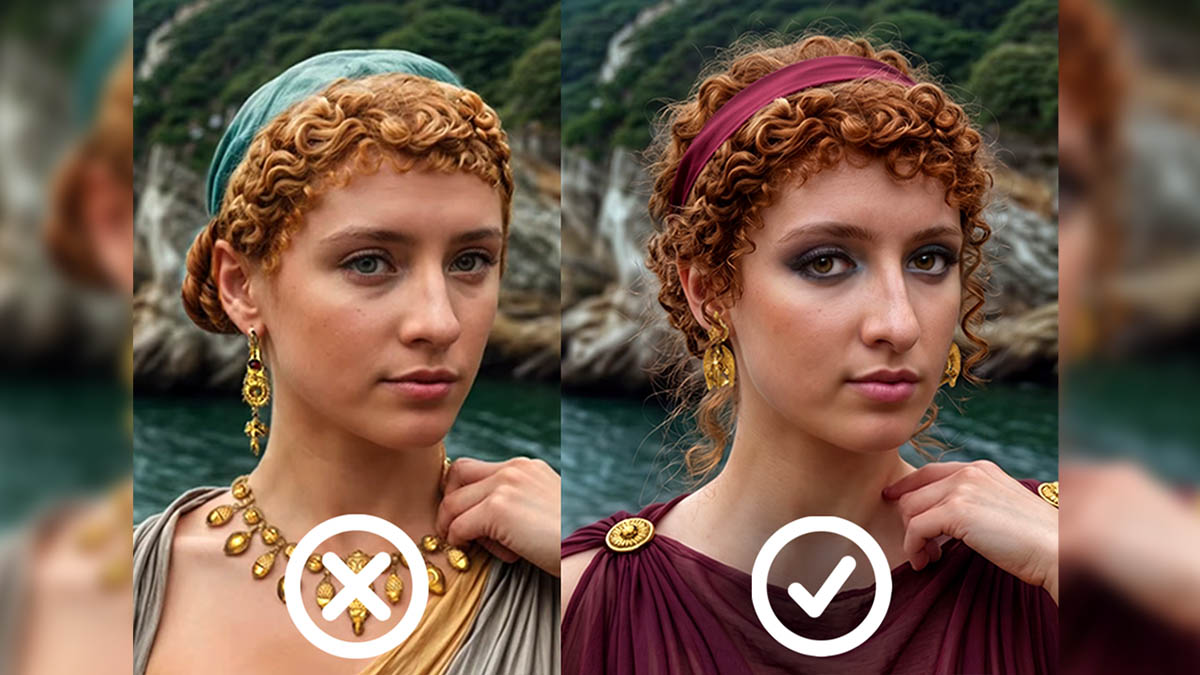
Costume references



Leave a Reply