
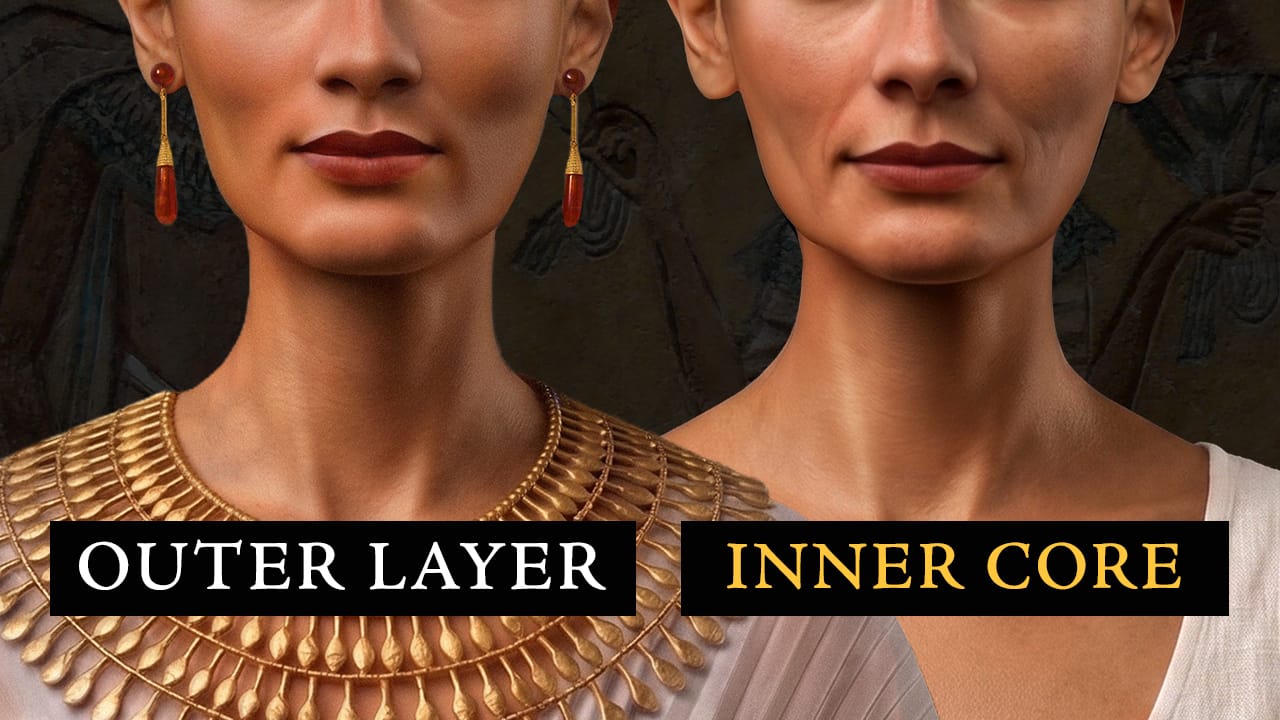

Only two millimeters below this serene, smooth stucco is a stone core showing the original face of the sculpture. It shows more age, a less defined bone structure, even a tiny bump on the nose.

The most recognizable face from the ancient world has been smoothed over, and it’s believed that someone expressly ordered these changes. But who? And why?
The Art of the Amarna Period
Why do we have such a beautifully realistic statue of Nefertiti in the first place?

The Amarna era offers the most realistic sculpture works in Egypt’s history. Her husband, Pharaoh Akhenaten’s new religion focused on the sun, more on nature and how things really appear in the world, so he ordered that things be sculpted like they actually appeared. We can see individual characteristics in these portraits that are simply not present earlier in Egypt’s history, or even after.
His style allowed pharaohs to be normal – to be human. He’s even ordered warm, affectionate family portraits to be made.

A Forgery Debate is Still Raging
Now, some people argue that the sculpture of Nefertiti is a forgery. There are some legitimate reasons to be suspicious, and many legitimate reasons to believe it’s authentic. You can learn more about her discovery and the forgery debate in our video here.
To scholars, the fact that there is a stone core to the sculpture is a direct rebuttal to the counterfeit theory. Why would a forger take the time to sculpt a stone core and then cover it with stucco? A forger wouldn’t go to the trouble of creating an inner face that no one would ever see.
Reconstruction of the Nefertiti Bust – the Faithful Version
First, I want to show a reconstructed view of the Nefertiti we all know, with period accurate jewelry and clothing. And then we’ll talk about the changes and compare it to the reconstruction of the underlayer I’ve made. Let’s take a look at that now.

To this image, I’ve added New Kingdom style beaded earrings, a reconstructed version of this collar from the Metropolitan Museum, a bracelet also from her era, and a Kalasiris dress, which was a pleated light linen gown worn over an underdress.
Reconstructions of the Inner Stone Core of the Nefertiti Bust
After constructing this Nefertiti – the one that matches her statue exactly – I moved to tackle the inner core, and possibly find the truer face of the Queen.
I stripped back her jewelry and her crown, making multiple angles in short hair and a linen shift – likely what she would like while alone in her chambers. This is so we can really focus on her features.
So what are the differences between the stone core and the finished product?
The scans revealed a barely visible bump in her nose bridge that was smoothed away in the final version. Her nostrils have also been made noticeably smaller.

The left eye was raised, probably for symmetry, and the eyelids became more stylized with these pointed corners in the final version.

The most obvious differences are in her mouth and chin area – the chin has been noticeably lengthened for the finished version, with the lines around her mouth smoothed out, and her cheekbones made more prominent.

Here’s the finished product. These are very slight, incremental changes, but they do reveal a different woman – a real woman. It’s a look at Nefertiti the woman, instead of Nefertiti the symbol.

Who made these changes to the Nefertiti bust and why?
The Egypt Museum describes these images in progression as going from “rough study to divine image.” And that is a great way to think about it.

Thutmose clearly presented his initial drafts to the palace, and the palace had notes. But why change these specific things?
The way this is commonly framed is that they simply wanted to make her look younger and prettier, which is possible, but oversimplifies everything.
The most likely explanation is that the changes weren’t just cosmetic – they were religious. I noticed all of the requested changes had a smoothing function. They morph the image from that of a real woman to being an icon or cult figure. The changes made everything more symmetrical – more divine.
I think we can safely say that the underlayer is a more true depiction of the woman Nefertiti.
But this beautiful sculpture is in fact, an enigma, leaving many, many questions unanswered. We can now see two faces of Nefertiti, and we still can’t say which one she actually wore.


Leave a Reply