
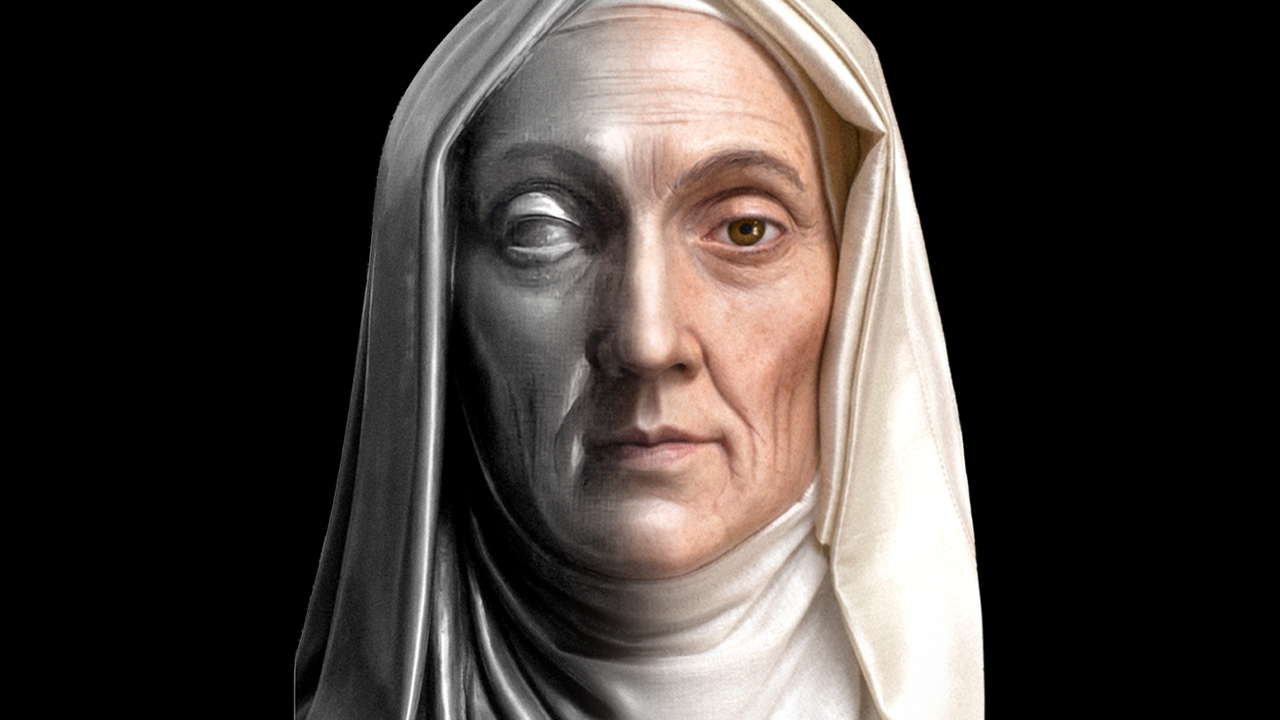
You may never have heard of Margaret Beaufort. A woman of astonishing intelligence and foresight, she has only recently begun to get proper credit as the mastermind behind several watershed moments in English history.
In this article, we discuss who Margaret was and key facts about her life. Below, we will talk about what Margaret Beautfort really looked like and reveal our lifelike re-creations of the Tudor Matriarch.
If you’d rather watch this article in video format, check out her 15 minute history & facial reconstructios video here.

The Portraits: What Did Margaret Beaufort Actually Look Like?
Search for Margaret Beaufort online and you will meet the same woman over and over again: elderly, austere, hands clasped, kneeling at prayer in a white wimple and dark mantle. The National Portrait Gallery holds around twenty images associated with her, and almost every one shows her as an aged widow dressed very nearly as a nun.
There is no reliable portrait of Margaret as a young woman. The girl who gave birth to a future king at thirteen simply does not survive on panel — and may never have been painted at all.
The Forgery – What Scholars Hoped was a Portrait of Young Margaret
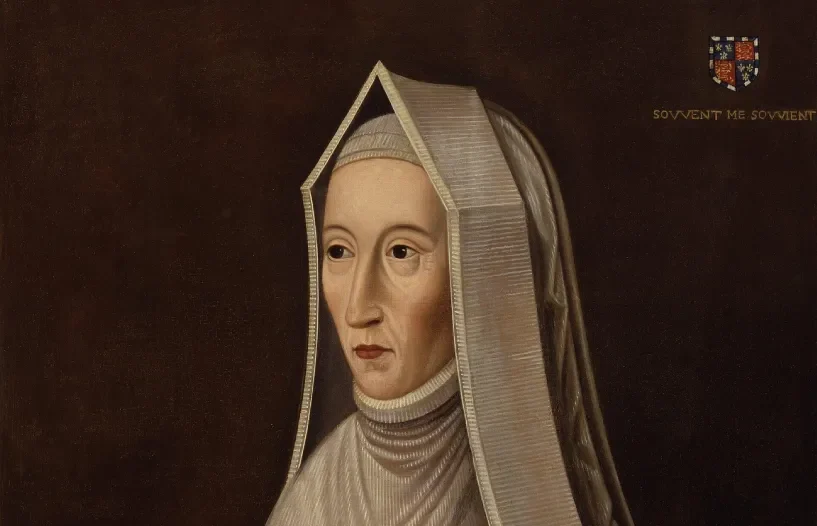
For a long time, the great hope was a panel now in the National Portrait Gallery showing a young woman in a 1490s gable hood, with the Beaufort arms displayed beside her. If genuine, it would have been a treasure.
It was doubted almost from the moment the Gallery first saw it. When it was shown to George Scharf, the NPG’s first director, he was unconvinced — he sketched it on the back of the owner’s letter and wrote it off as a fabrication. The panel was resold, and by the time it resurfaced at auction in 1908 Scharf’s verdict had been forgotten. The Gallery bought it as a portrait of Lady Margaret Beaufort.
Scharf’s successor-but-one, Sir Charles Holmes, wrote a sceptical report in January 1911, noting that the image was painted on very fine linen laid onto a modern panel, and that the coat of arms was a later addition. His suspicions were confirmed in 1939, when two x-ray photographs revealed a completely different image underneath — a woman’s head thought to come from an early sixteenth-century Flemish altarpiece. Someone in the nineteenth or early twentieth century had overpainted it with a period hood and Margaret’s maiden arms, almost certainly to make a sale.
Copies of the fake exist at Christ’s College, Cambridge and at Lady Margaret Hall, Oxford, which is how thoroughly it fooled people.
A new portrait, identified in 2019
Fortunately, we do have two reliable likenesses — and one of them is the subject of a genuinely thrilling piece of recent scholarship.
A large painting had hung for centuries in the Master’s Lodge at St John’s College, Cambridge — one of the colleges Margaret founded — showing an older woman kneeling at a prayer desk in a richly furnished closet. In April 2019, Dr Andrew Chen of Cambridge and Dr Charlotte Bolland of the National Portrait Gallery published their findings in The Burlington Magazine. Documents in the college archives recorded a portrait of Lady Margaret by the painter Meynnart Wewyck arriving at St John’s; dendrochronology dated the oak panel to trees felled after 1487 and 1489, with the panel itself constructed before 1521. The two strands of evidence locked together.
Wewyck was a Netherlandish painter who had been Henry VII’s own preferred artist, active at the English court from around 1502. Until 2019 not a single surviving work could be securely attributed to him. This is now the anchor of his entire body of work.
It was commissioned by Bishop John Fisher, Margaret’s confessor and executor, around 1510–12 — immediately after her death. At over 180 cm tall and 122 cm wide, it is now believed to be the earliest large-scale portrait of an English woman in existence, and one of the earliest large-scale portraits of any single individual in Britain.
How do you paint a woman a year after she has died? Two answers, and they aren’t mutually exclusive. Wewyck was working at the English court from 1502, so he may well have seen Margaret in life. And, like her son Henry VII, Margaret is believed to have had a death mask taken after embalming — a mask that would have served both this painting and her tomb effigy.
The portrait has since undergone a monumental conservation project at the Hamilton Kerr Institute — over 1,500 hours of work stripping away centuries of varnish and later overpaint — and now hangs as a centrepiece of the National Portrait Gallery’s Tudor galleries in London. Every earlier “standard” image of Margaret, including the widely reproduced NPG 551, appears to descend from this composition.
The tomb effigy: A beautiful, naturalistic look at the real face of Margaret Beaufort
The second reliable likeness is sculptural. Margaret’s tomb in the south aisle of the Henry VII Lady Chapel at Westminster Abbey was contracted in November 1511 and executed by the Florentine sculptor Pietro Torrigiano — the same artist responsible for the tombs of Henry VII and Elizabeth of York.

The gilt-bronze effigy shows her in old age in widow’s dress, hood and long mantle, her head resting on two pillows worked with the Beaufort portcullis and the Tudor rose, with the Beaufort yale (a mythical beast with swivel horns, now lost) at her feet. Westminster Abbey’s own account notes that the face was probably modelled on a death mask, and that the effigy was produced using a wax-cast technique that allowed extremely fine detail.
And the detail is the point. The hands are raised in prayer, delicate, and unmistakably wrinkled — a wonderfully lifelike inclusion by the artist, and not the sort of thing a sculptor invents. Traces of original colour survive on the hands, wimple and the trimming of her mantle. The face is thin, with high cheekbones, drawn cheeks and a strong hooked nose.
Her Coloring
Skin tone we can take from the Wewyck portrait. Hair and eyes are far harder. Almost every image shows her in a widow’s hood and wimple, so there is essentially no hair visible anywhere in her iconography. The portrait gives us eyes that read as either dark blue or brown depending on the light and the state of the varnish, beneath delicately arching brown eyebrows. Her son Henry VII, for what it’s worth, was recorded as red-haired with grey/blue eyes.
The Reconstructions
So here’s what I’ve done. Working from Torrigiano’s death-mask-derived effigy, I’ve built the Margaret Beaufort who died at sixty-six – the face we can actually evidence.
Then, I’ve built an educated-guess version of a younger Margaret, regressing the bone structure the effigy gives us. This second one is an interpretation, and I want to be clear about that. The first is as close to her real face as the surviving evidence allows.
Let’s see the face of this extraordinary woman.


Sources & Further Reading
The portraits and their attribution
- Hamilton Kerr Institute, Fitzwilliam Museum — “Lady Margaret Beaufort restoration on display at National Portrait Gallery”
- National Portrait Gallery — NPG 1488, Unknown woman, formerly known as Lady Margaret Beaufort
- National Portrait Gallery — NPG 551, Lady Margaret Beaufort
- National Portrait Gallery — all portraits associated with Lady Margaret Beaufort
- Art UK — “My lady, the king’s mother: images of Margaret Beaufort”
The tomb and effigy
- Westminster Abbey — Margaret Beaufort, Countess of Richmond
- Historic England / Warburg Institute — archival photography of the Torrigiano effigy in the Henry VII Chapel
Primary and biographical sources
- John Fisher, A Mornynge Remembraunce (1509), in The English Works of John Fisher, ed. J. E. B. Mayor (Early English Text Society, 1876) — full text on the Internet Archive
- Nicola Tallis, Uncrowned Queen: The Fateful Life of Margaret Beaufort, Tudor Matriarch (2019) — the best recent popular biography.
- Tudor Times — Margaret Beaufort: Appearance & Possessions
Costume references




Leave a Reply