
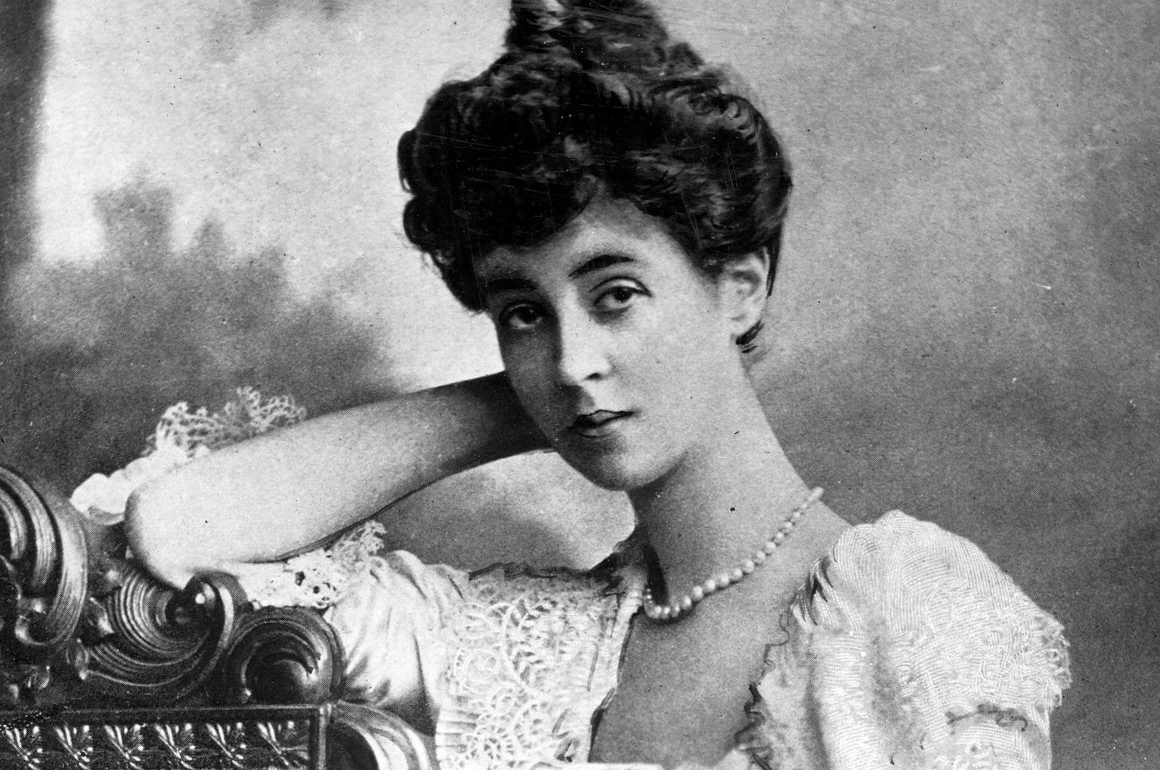
Consuelo Vanderbilt was an American heiress, trapped between two worlds – the old, and the new. One of the richest heiresses of the gilded age, she was among the famous “Dollar Princesses” – rich young women from America, sent to marry British lords in order to trade new money for prestige. The marriages of alliance and convenience were going out of fashion – marrying for love was on the rise, but Consuelo would not be so lucky.
Her life was the classic “gilded cage” – full of travel, riches, and luxury – that also happened to be utterly miserable, at least until she was able to escape, and make a life entirely on her own terms.
To watch this article as a video with facial re-creations of Consuelo Vanderbilt, click here.

1. The industrial revolution had just changed everything about her world
Starting in the 1880s, massive English estates, once bustling with hundreds of servants, began their decline. New political movements were elevating the lower classes, mobilizing those who found the old ways archaic. These estates used to have massive incomes from tenant rents and vast farmlands, but were now struggling to find competent workers – the wages and hours in factories were simply better. The world order was changing.

2. Her childhood was shaped by a very strict mother
Consuelo was born on March 2nd, 1877, in New York City, to William Vanderbilt and socialite and suffragette Alva Erskine Smith. The Vanderbilts were the original American railroad money family, but in Gilded Age New York they were “new money,” considered kind of tacky by the old guard of high society. Her mother Alva was determined to change that.
And Alva’s plans were very, very strict. Taught by private governesses, Consuelo was speaking French and German by the age of eight and was trained in music, art and etiquette. In her memoir, she describes being made to wear a steel rod that ran up and down her spine and fastened around her waist, to ensure her posture never faltered.
Any disobedience could be met with a whipping from her mother’s riding crop. As a little girl, Consuelo had real spirit, loved reading and had a vivid imagination, but when she objected to something, even the clothing Alva picked out for her, she was met with harsh words and punishments. Alva repeatedly told her, “I do the thinking, you do as you are told.” Slowly, that independent spirit faded away.

3. She was forced to marry a duke while in love with someone else
Consuelo’s mother, Alva, had set her sights for Consuelo on Charles Spencer-Churchill, the 9th Duke of Marlborough, owner of Blenheim Palace, one of the largest and grandest palaces in England. He had power, prestige and a close friendship with Winston Churchill. What he didn’t have was the money to keep his estate running.

But Consuelo was already in love with Winthrop Rutherfurd, a New York socialite considered one of the handsomest bachelors in town, and planned to elope with him. To Alva, an American gentleman simply wasn’t good enough. She intercepted their letters, swept Consuelo off to Europe and forbade her from seeing Rutherfurd. Back in Newport, Consuelo was literally locked away to keep her from eloping.
When Consuelo still refused, Alva gave word that her heart was failing from stress, and one more blow might kill her. A heartbroken Consuelo finally gave in, and Alva made a miraculous recovery.
On November 6, 1895, Consuelo married the Duke at St. Thomas Church on Fifth Avenue. She later wrote that she spent the morning of her wedding in tears and arrived about twenty minutes late, her face swollen from crying beneath her veil. The Duke received a staggering dowry of $2.5 million in railroad stock.

4. She coined the phrase “the heir and the spare”
Consuelo’s duties as duchess were to entertain endless guests and, above all, produce an heir. The Duke’s grandmother reportedly told her plainly that this was her first duty, because otherwise the dukedom might pass to the Duke’s cousin, Winston Churchill.
Consuelo did what was expected of her. Her son John was born in 1897, and her second son, Ivor, followed quickly in 1898. She actually coined the term “the heir and the spare.”
Even though her marriage was unhappy, Consuelo shone as a duchess. The tenants and villagers around Blenheim adored her, and she poured her energy into charity work, visiting the sick and the poor. In 1902, she was one of four duchesses chosen to hold the canopy over Queen Alexandra at the coronation of King Edward VII. She also struck up a lifelong friendship with Winston Churchill, the very cousin her sons had pushed out of the line of succession.

5. Both Consuelo and the Duke had multiple affairs
Consuelo and her husband, the Duke of Marlborough, weren’t under romantic illusions about what their marriage was supposed to be. She knew she was there, with her money, to save Blenheim Palace from ruin, and the Duke knew that as well.
Both of them were fairly content to look the other way while the other had affairs.
The Duke became involved with American Gladys Deacon, and Consuelo had reconnected with her first love, Winthrop Rutherford in Paris not long after the marriage. In fact, Gladys Deacon later implied their second child was really Rutherford’s, although of course this has never been confirmed.
She also had an alleged affair with French artist Paul Helleu, who sketched her in these beautiful, intimate portraits.

By the early 1900s, the Marlboroughs’ marriage had completely fallen apart. The Duke was cold and controlling, and both he and Consuelo had become involved with other people. When Consuelo hatched a plan to elope with Charles, the Viscount Castlereagh, a married father of two, the Duke knew the marriage had to end. In 1906, the couple informally separated.
6. After her marriage fell apart, she turned her attention to women’s rights
For most women of her era, a divorce would have meant social ruin. But Consuelo refused to fade away. She kept Sunderland House, their London mansion, and threw herself into public life. She campaigned for women’s rights and the vote, supported housing and care for working women and their children, and in 1917 won a seat on the London County Council.
The girl who was once told “I do the thinking, you do as you are told” was now the one giving speeches. And in a twist no one saw coming, her mother Alva had become a passionate suffragist herself, and the two women slowly rebuilt their relationship.

7. She finally married for love, then fled the Nazis
In 1921, Consuelo and the Duke were finally divorced. Just months later, on July 4, 1921, Consuelo married the man who would make her truly happy: Jacques Balsan, a dashing French aviator and industrialist. He had fallen for her years earlier, when she was just 17, at a ball in Paris. This time, there was no scheming mother and no dowry negotiations. Consuelo chose him herself.
The couple lived happily in France for nearly twenty years, and Consuelo founded a hospital outside Paris that is still among the top hospitals in France today. In August 1939, while hosting Winston Churchill and his wife in Normandy, they heard Winston’s belief that war was now imminent.
In 1940, with Nazi forces sweeping through France, the couple was forced to flee, escaping through Spain and Portugal before making their way back to the United States. Consuelo was particularly instrumental in evacuating children from hospitals before the Germans could arrive.
The glitter and the gold
In 1953, Consuelo published her memoir, The Glitter and the Gold, finally telling her story in her own words. It surprised many readers with its candid accounts, and it’s still the reason we know so much about her today. She described the first half of her life as the “glitter,” and the second half, with her happy marriage and family, as the “gold.”
Consuelo Vanderbilt died on December 6, 1964, in Southampton, New York, at the age of 87. At her own request, she was buried in England, in the churchyard at Bladon near Blenheim Palace, beside her son Ivor. Hers is a fascinating story of a woman straddling two worlds, the old and the new, and making the most of both of them.
You might also like to learn about what Marie Antoinette really looked like.




Leave a Reply